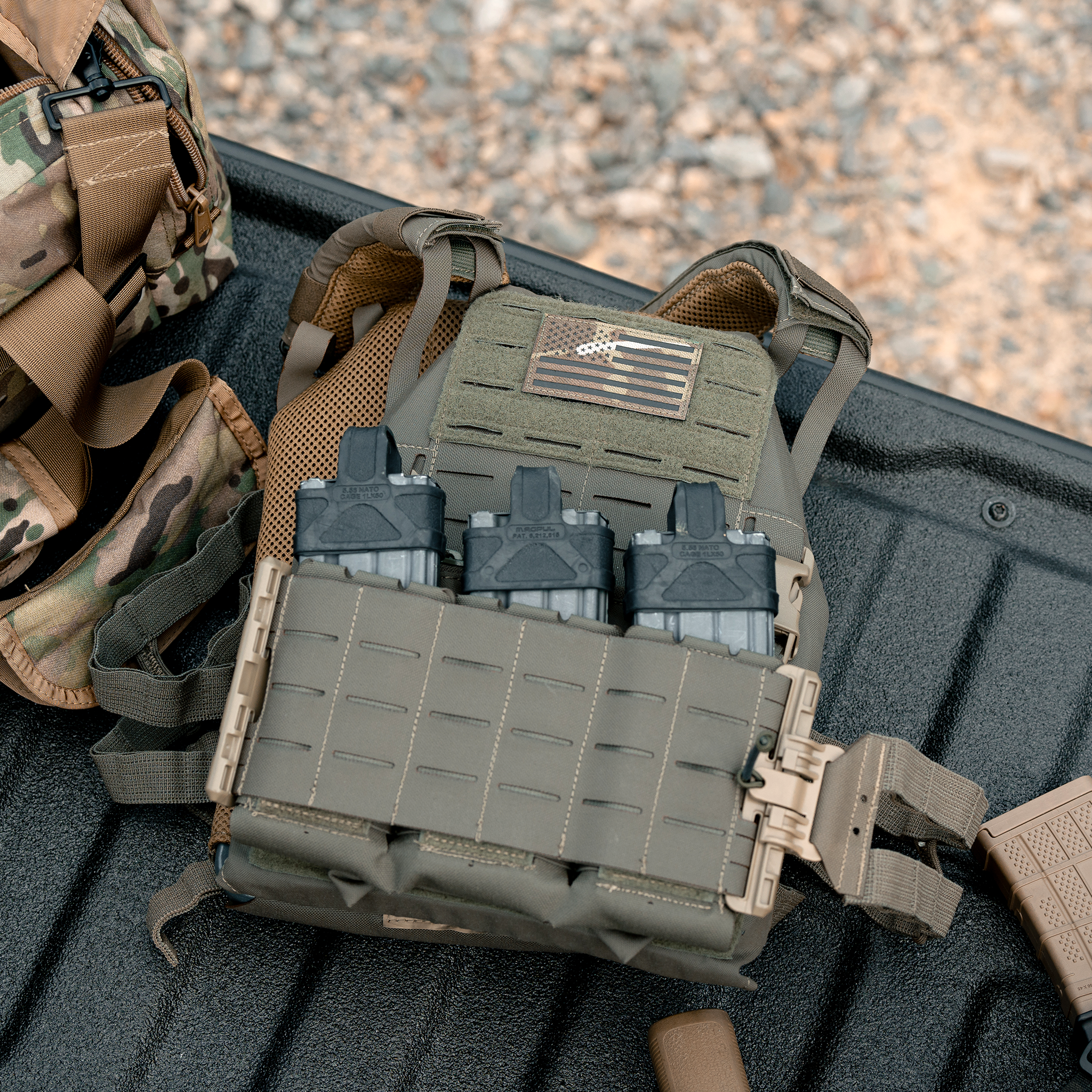
Choosing the right plate carrier for soft armor isn’t just about fit; it directly impacts comfort, mobility, and protection. Whether you're in law enforcement, security, or preparing for personal defense, using the wrong carrier can lead to shifting panels, poor coverage, and reduced effectiveness.
In this guide, we’ll break down how to choose a plate carrier for soft armor, including compatibility, sizing, and key features to look for.
What Is a Plate Carrier for Soft Armor?
Choosing the right body armor configuration can be the difference between life and death in a high-threat environment. A plate carrier is designed to house hard ballistic plates, and is the tactical standard for professionals who need modular, scalable protection without sacrificing mobility.
A tactical plate carrier is a purpose-built vest that holds rigid armor plates in front, rear, and optional side armor pockets. Unlike a traditional bulletproof vest, which relies entirely on soft ballistic fabric, a plate carrier is engineered to work with hard rifle plates that defeat rifle-caliber threats. The carrier itself is the platform; the plates provide the protection.
What makes the modern tactical plate carrier especially versatile is its modularity. Operators can configure their loadout based on mission requirements — adjusting coverage, weight, and threat level as needed. Decisions must account for both threat environment and wearer comfort — two factors that directly shape carrier selection.
One of the most common questions professionals ask is whether soft armor can be integrated directly into a plate carrier setup. That compatibility question is more nuanced than it might first appear.
Can You Use a Plate Carrier with Soft Armor?
The short answer is yes — but with important caveats worth understanding before you configure your setup.
A plate carrier is primarily designed to hold rigid rifle plates, yet many modern carriers also feature soft armor pockets or cummerbunds that accept flexible ballistic panels. This dual-use design gives wearers meaningful flexibility depending on the threat environment. In low-threat situations where mobility matters most, soft armor panels alone can provide adequate protection. In higher-threat environments, body armor with plates layers rigid and soft protection together for a more comprehensive solution.
The configuration you choose should match the threat level you're facing — not simply what's convenient or available.
A combined setup typically includes:
-
Soft armor backer panels inserted behind rigid rifle plates
-
Soft armor side panels integrated into the carrier's cummerbund for wrap-around torso coverage
-
Standalone soft armor used in the plate pockets when rigid plates aren't required
However, it's worth noting that not every plate carrier accommodates soft armor inserts. Fit, pocket dimensions, and material compatibility all matter. Always verify your carrier's specifications before purchasing soft armor panels separately.
Understanding what protection soft armor delivers — and where its limitations lie — is the critical next step in building a mission-ready loadout.
What Is Level IIIA Soft Armor (and What Does It Stop?)
Understanding the protection level you're working with is essential before you configure any tactical plate carrier setup. Level IIIA is the highest-rated soft armor classification under the NIJ standard — and it's the most common choice for professionals who need flexible, concealable protection without the bulk of hard plates.
Level IIIA soft armor is rated to stop handgun rounds up to .44 Magnum and .357 SIG, including 9mm, .40 S&W, and .45 ACP. It's engineered from tightly woven ballistic fibers — typically Kevlar or Polyethelene — layered to absorb and disperse kinetic energy on impact. In practice, this coverage addresses the majority of threats encountered in law enforcement and civilian defense scenarios.
However, there are clear limitations worth acknowledging:
-
It will not stop rifle rounds — that's where hard plates become critical
-
It offers no protection against armor-piercing ammunition
-
Repeated impacts can degrade ballistic performance over time
As the industry saying goes: there is no such thing as a truly bulletproof vest — only varying degrees of ballistic resistance matched to specific threat levels.
NIJ certified body armor at Level IIIA is tested and validated against standardized threats, giving wearers a reliable performance benchmark. But knowing what soft armor can and can't do naturally leads to the next critical question: how do you choose the right carrier to pair with it?
For a deeper dive into NIJ standards, check out our blog “Decoding NIJ Standards”.
How to Choose the Right Plate Carrier for Soft Armor
Now that you understand what Level IIIA protection offers, the next logical question is: which tactical plate carrier actually works well with soft armor panels? The answer depends on several practical factors — and making the wrong call can undermine the protection you're counting on.
Fit compatibility is the first checkpoint. Not every carrier is designed to accommodate soft armor inserts. Before purchasing, verify that the carrier explicitly supports a bulletproof vest panel or soft armor backer. Many modern carriers include dedicated soft armor pockets behind the primary plate pocket — look for that feature specifically.
Here are the key criteria to evaluate:
-
Panel pocket dimensions — Soft armor panels come in standard sizes (8”x10”,10"×12", 11"×14"), so confirm the carrier's pocket dimensions match your panel size
-
Retention system — Velcro closures or integrated pockets keep panels secure and prevent shifting during movement
-
Cummerbund compatibility — Side soft armor panels require cummerbunds with dedicated soft armor pockets, not just MOLLE webbing
-
Adjustability — Shoulder straps and side straps must allow precise positioning so the carrier sits correctly on your torso
One practical consideration: a carrier that's too large for your torso won't hold soft armor panels in the right position regardless of how well-built it is. Even quality body armor with plates performs below its rated protection level when panels drift out of alignment.
See our blog on finding the proper carrier fit for more information.
TL;DR for finding the perfect fit:
-
Always size your plate carrier to your soft armor panels
-
Look for secure, snug-fitting pockets to prevent shifting
-
Prioritize comfort features like padded straps and ventilation
-
Consider side armor based on your threat level
Why Fit Matters (Avoiding Panel Shift and "Slumping")
Choosing the right tactical plate carrier is only half the equation. How that carrier fits your body determines whether your ballistic plates and soft armor panels actually stay where they're supposed to when it counts most.
Panel shift happens when soft armor drifts out of position during movement — crouching, running, or transitioning between positions. When panels migrate downward or to the side, critical areas of your torso are left exposed. "Slumping" is a related issue where a poorly fitted carrier allows the entire front panel to droop, pulling protection away from your chest and upper abdomen.
Key fit principles include:
-
The high-and-tight rule: Soft armor should sit high enough that the top edge is roughly at your collarbone, not your sternum.
-
Cummerbund tension: A loose cummerbund allows lateral shift. Snug, even pressure keeps panels centered.
-
Shoulder strap adjustment: Straps set too long create a forward tilt that accelerates slumping under load.
In practice, even a well-constructed bulletproof vest or body armor carrier loses effectiveness if it's sized incorrectly or adjusted without care. Always size for your torso length, not just your chest circumference.
Fit is especially critical when you start adding body armor with plates to the equation — a topic we'll explore further when we look at side armor coverage next.
Do You Need Side Armor?
Once you've dialed in fit and panel placement, a natural next question emerges: should you extend that protection to your flanks? It's a worthwhile consideration, and the answer depends heavily on your role, environment, and threat profile.
Most standard tactical plate carriers are designed around front and back coverage. However, the sides of the torso — particularly the floating ribs and lower lungs — remain exposed in that configuration. Soft armor inserts designed for side pockets can close that gap without adding the bulk of hard plates.
Side armor coverage is only as effective as the carrier designed to hold it. If your carrier doesn't include dedicated side plate pockets or cummerbund pouches, adding lateral protection simply isn't an option without upgrading your setup.
Here's when side armor genuinely makes sense:
-
Elevated threat environments where flanking fire is a realistic concern
-
Vehicle operations, where lateral exposure increases significantly
-
Extended wear scenarios where comprehensive coverage outweighs weight trade-offs
On the other hand, side panels add weight and can restrict mobility — two factors worth balancing carefully against your actual risk level.
For most civilian and law enforcement users operating in lower-threat environments, front and back body armor coverage is typically sufficient. But if your mission profile demands more, carriers that accommodate lateral soft armor inserts exist specifically for that purpose — which brings us directly to evaluating the top options available today.
Best Plate Carriers for Soft Armor (Top Options)
By this point, you understand that soft armor can be used inside many plate carriers — but not all carrier designs integrate soft armor in the same way. There are two proven approaches to running Level IIIA panels inside a carrier, and understanding the difference helps you choose the setup that best fits your needs. Caliber Armor’s soft body armor and plate carriers are tested and verified to meet or exceed ballistic resistance as specified under NIJ Standard- 0101.06 IIIA and 0101.07 HG2.
Most plate carriers on the market are designed to accept standard-sized soft armor panels inside plate pockets or cummerbund sleeves. These carriers work with common panel dimensions like 10"×12" or 11"×14", allowing users to insert soft armor behind plates or along the sides for additional handgun-rated protection. When properly sized and adjusted, this method is effective, versatile, and widely used.
Another category of carrier is built specifically around custom-cut, wraparound soft armor panels designed for that exact carrier platform. In these systems, the soft armor is shaped to match the carrier’s profile, creating continuous torso coverage from front to sides to back without relying on rectangular inserts placed into generic pockets.
Each approach offers distinct advantages.
Standard panel-compatible carriers allow you to:
-
Use widely available soft armor sizes
-
Swap panels between carriers if needed
-
Build a modular system around armor you may already own
-
Configure protection using familiar, proven panel dimensions
Wraparound, carrier-specific soft armor systems provide:
-
Continuous ballistic coverage around the torso
-
Panels that naturally stay in position without shifting or slumping
-
Improved comfort because the armor follows the body’s contour
-
A design where the carrier and soft armor function as a single system
In both cases, hard rifle plates can still be added when higher-level protection is required.
The key is not which method is “better,” but which one aligns with your role, your threat environment, and the equipment you already have. Both are effective ways to run soft armor inside a plate carrier when the carrier is properly sized and designed to support it.
What Size Plate Carrier Do You Need for Soft Armor?
Choosing the right size plate carrier for soft armor starts with one key rule: measure your armor panels first, not your body. Soft armor inserts are manufactured in specific dimensions, and your carrier needs to match those measurements closely to ensure proper coverage and performance.
Most soft armor panels come in standard sizes like 10"×12" or 11"×14", but sizing can vary depending on the cut and manufacturer. A carrier that’s too small can compress the panels, potentially affecting comfort and flexibility, while a carrier that’s too large allows the armor to shift—creating dangerous coverage gaps.
For the best fit:
-
Match the carrier’s pocket dimensions to your exact panel size
-
Ensure the carrier sits high on your torso, with the top edge near your collarbone
-
Avoid oversized carriers that rely on adjustment straps alone to compensate for poor fit
Ultimately, the right size plate carrier keeps your soft armor secure, properly positioned, and effective—which is exactly what you need when it matters most.
TL;DR To getting the right plate carrier fit:
-
Measure your panels first
-
Match carrier pocket size
-
Avoid too tight (compression) or too loose (shifting)
-
Fit should align with torso, not just chest size
Final Thoughts: Choosing the Right Setup
Choosing the right plate and carrier setup isn’t just one decision—it’s a combination of factors that all impact how your armor performs. From understanding how NIJ certified body armor standards define your protection level, to dialing in fit and panel placement, every variable you've worked through in this guide contributes to a setup that's genuinely mission-ready.
One point worth reinforcing: ICW plates — designed to work in conjunction with a soft armor backer — only perform as rated when the full system is assembled correctly. Pairing the wrong components doesn't just underperform; it creates a false sense of security that can prove critical in the field.
The right setup is the one that fits your threat profile, your body, and your operational demands — not just the one with the highest rating.
Summary and Key Points
-
Match your body armor with plates to verified threat levels
-
Prioritize fit above all else in your soft armor plate carrier
-
Consider Level IV body armor for rifle-rated environments
-
Evaluate whether side armor fills a real gap in your coverage
Choosing body armor is a long-term investment in protection. Take the time to get it right.