Do Backpack Armor Inserts Actually Work?
Backpack armor inserts do work — but only within clearly defined limits, and understanding those limits could save a life. The question of “do bulletproof backpack inserts?” work is one that deserves a precise, evidence-based answer rather than a marketing slogan.
Quick Answer: Do Backpack Armor Inserts Work?
-
No armor is truly bulletproof.
-
Yes, when properly rated and used as intended.
-
Most backpack armor inserts are designed to stop common handgun threats.
-
Protection depends on testing, coverage area, and threat level.
-
While backpack armor inserts cannot be NIJ certified, the most reputable products are independently tested to NIJ ballistic standards and provide documented performance against specified threats.
No armor is "bulletproof" — the accurate term is "bullet-resistant." This distinction matters enormously. A backpack insert rated for handgun rounds won't perform against rifle-caliber threats, and no body armor guarantees zero injury. Blunt trauma remains a real factor even when penetration is prevented. Equipping a backpack with soft armor does not make a backpack armor bulletproof shield for anyone.
Soft armor, typically rated at NIJ Level IIIA, functions by dispersing the kinetic energy of an incoming round across a woven matrix of high-tensile fibers. Rather than stopping a bullet through brute rigidity, the material deforms and spreads the energy load, dramatically reducing the force transferred to the body behind it. According to the National Institute of Justice, Level IIIA armor is engineered to stop most handgun rounds, including .44 Magnum and 9mm rounds — the threat profile most relevant to civilian incidents.
Coverage area is another critical variable. A properly sized insert must align with the vital zone across the wearer's back. An undersized panel leaves gaps; an oversized one may not fit securely, shifting under stress and reducing effectiveness.
These inserts are purpose-built for the most statistically common civilian threat of handgun fire. Understanding that scope is the foundation of making an informed choice. The next critical layer of that decision is testing, and not all testing results carry equal weight.

What Can Backpack Armor Stop?
Most backpack armor inserts are designed to protect against common handgun threats rather than high-velocity rifle rounds. For example, NIJ Level IIIA armor is tested to stop many handgun calibers, including 9mm, .40 S&W, .45 ACP, and .44 Magnum.
However, standard Level IIIA backpack insert armor is not designed to stop rifle threats such as .223 Remington, 5.56 NATO, or .308 Winchester. Protection capabilities vary by armor type, material, and certification level, which is why verifying the armor's rating is critical before making a purchase.
|
Threat Type |
Typical Level IIIA Backpack Armor |
|---|---|
|
9mm Handgun |
Yes |
|
.40 S&W |
Yes |
|
.45 ACP |
Yes |
|
.44 Magnum |
Yes |
|
Shotgun Buckshot |
Varies by load and armor rating |
|
Rifle Rounds (.223, 5.56, .308) |
No |
|
Armor-Piercing Ammunition |
No |
Understanding NIJ Standards: What Actually Matters
Not all ballistic products are created equal, and the gap between marketing language and verified performance can have serious consequences.
The NIJ 0101 series of standards, published by the National Institute of Justice, serves as the benchmark for ballistic resistance testing in the United States. These standards establish specific test methods, threat levels, and performance requirements used throughout the armor industry. When shoppers ask whether backpack armor inserts actually work, the answer depends heavily on how the product was tested and whether those results can be verified.
One of the most important distinctions consumers should understand is the difference between a product that is "tested to NIJ standards" and one that is "NIJ certified." Traditional body armor systems may be eligible for NIJ certification through the NIJ Compliance Testing Program. However, backpack armor inserts are not eligible for NIJ certification or inclusion on the NIJ Compliant Products List. As a result, reputable manufacturers instead rely on independent laboratory testing conducted to applicable NIJ ballistic standards and provide documentation supporting the armor's performance.
The testing itself goes far beyond simply stopping a bullet. Ballistic evaluations may include environmental conditioning, temperature exposure, moisture exposure, and other procedures designed to evaluate performance under real-world conditions. An armor panel that performs well in a controlled demonstration but cannot maintain that performance after years of daily use provides a false sense of security. That's why documented testing, transparent performance data, and reputable third-party validation are critical when evaluating any backpack armor insert.
Navigating the Legal Landscape of Personal Protection
Owning a backpack armor shield is legal for the vast majority of Americans — but a few key rules determine who can carry one and where.
Under federal law (18 U.S.C. 931), purchasing and wearing body armor is legal for any law-abiding citizen in all 50 states. There are no federal permits required, no registration process, and no mandatory training. However, individuals with a violent felony conviction are prohibited from owning body armor under that same statute — a restriction that carries serious federal penalties if violated.
State-level nuances are minor but worth noting. A small number of states, including Connecticut, add restrictions around purchasing armor in person versus online. In practice, these are narrow exceptions that don't affect most families considering a ballistic shield insert for a student's backpack.
Weight vs. Protection: Choosing the Right Insert for a Child
Choosing the right backpack armor insert for a child comes down to one practical truth: protection only works if the child actually carries it every day.
Weight is one of the most important factors when selecting a backpack armor insert. An armor panel that is too heavy quickly becomes a burden, increasing the likelihood that it gets left at home, removed from the backpack, or carried inconsistently.
Modern hybrid armor designs that combine UHMWPE (Ultra-High-Molecular-Weight Polyethylene) and aramid fibers can provide Level IIIA handgun protection while weighing around one pound, making them a practical option for everyday carry. Traditional aramid-only panels, often referred to by the brand name Kevlar®, can provide comparable protection but generally weigh more depending on the coverage area and construction.
Some people consider using steel body armor plates, such as AR500 steel plates, as an improvised backpack armor solution. While steel armor can offer excellent ballistic protection, it is not designed for daily backpack carry. Steel plates are significantly heavier than soft armor alternatives, adding several pounds to a backpack and creating comfort and usability concerns for children. In most cases, the added weight outweighs any potential benefit for this application.
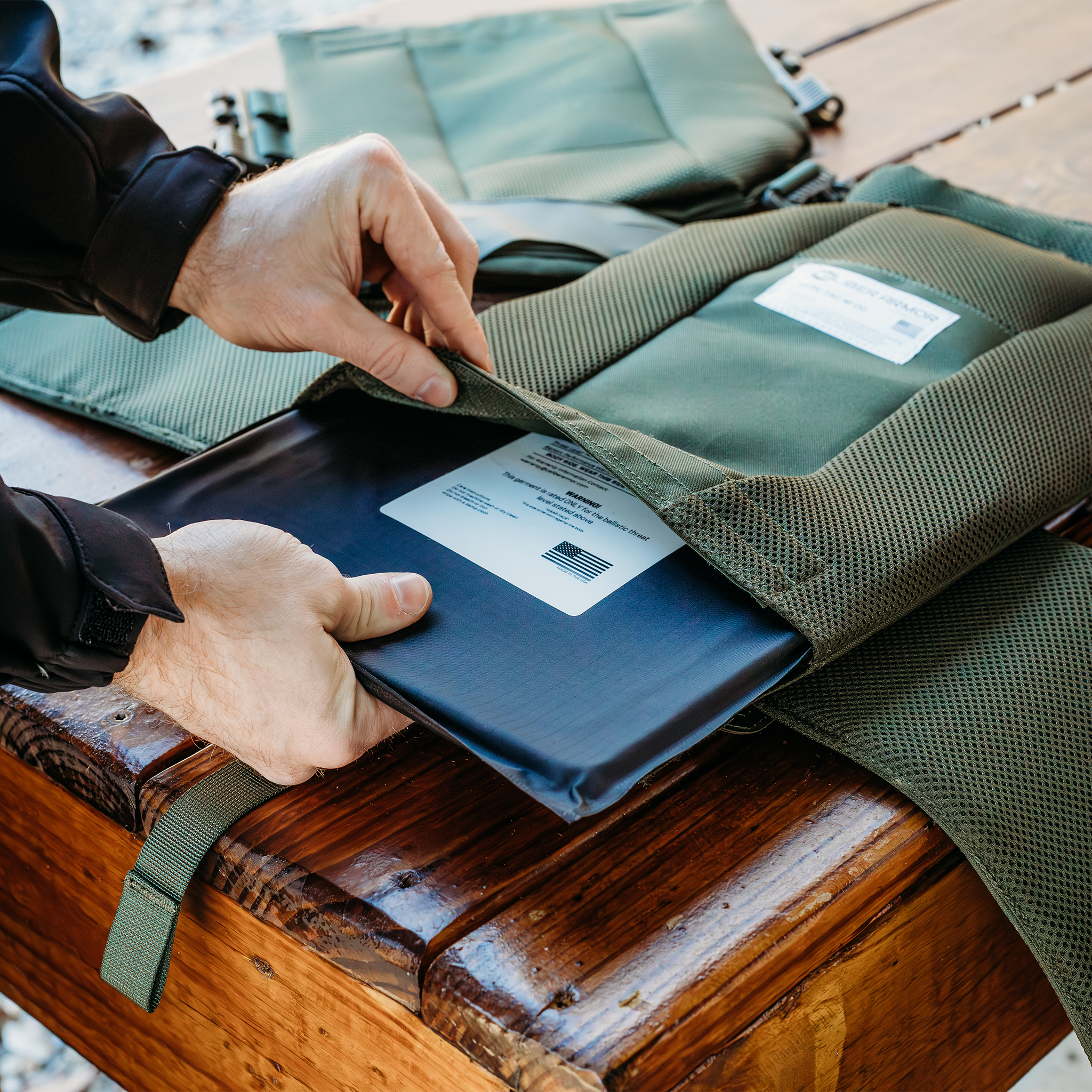
Placement within the backpack matters just as much as material selection. The armor insert should sit flat against the laptop sleeve or rear panel of the backpack, positioned to cover the torso and spine rather than shifting freely inside the main compartment. Proper placement helps maintain coverage and keeps the panel stable during normal daily use.
For most elementary and middle school students, lightweight soft armor panels offer the best balance of protection, comfort, and everyday practicality. The most effective armor is the armor that is consistently carried, making weight, fit, and comfort just as important as ballistic performance.
Final Verdict: Choosing the Right Backpack Armor
So, do bulletproof backpack inserts work?
Backpack armor inserts can provide meaningful protection when they are properly rated, correctly sized, and used as intended. While no armor is truly bulletproof, quality backpack armor inserts can help protect against many common handgun threats and provide valuable peace of mind for students, commuters, and everyday carriers.
Key Takeaways
-
Look for backpack armor that has been independently tested to applicable NIJ ballistic standards and is backed by documented test results.
-
Level IIIA backpack armor offers a practical balance of protection, weight, and everyday usability.
-
Ensure the insert fits securely inside the backpack to maintain proper coverage.
-
Replace armor according to manufacturer recommendations or after any ballistic impact.
-
Understand the armor's limitations and choose protection that matches your intended use.
When it comes to personal protection, informed decisions matter. Because backpack armor inserts are not eligible for NIJ certification, consumers should focus on products with transparent testing, documented performance data, and a proven track record from reputable manufacturers. The goal is not simply to buy armor—it's to choose protection that has been thoroughly evaluated and designed to perform when it matters most.